
王天笑
Assistant Professor Supervisor of Master's Candidates
Gender:Male
Alma Mater:吉林大学
Degree:Doctoral Degree
School/Department:化工学院
Discipline:Chemical Engineering
E-Mail:
Hits:
Date:2026-01-09
Indexed by:Journal Article
Date of Publication:2023-02-17
Journal:Progress in Organic Coatings
Included Journals:SCI
Volume:178
ISSN:0300-9440
Key Words:Magnesium alloy, Chitosan, Polylactic acid, Corrosion resistance, Biocompatibility
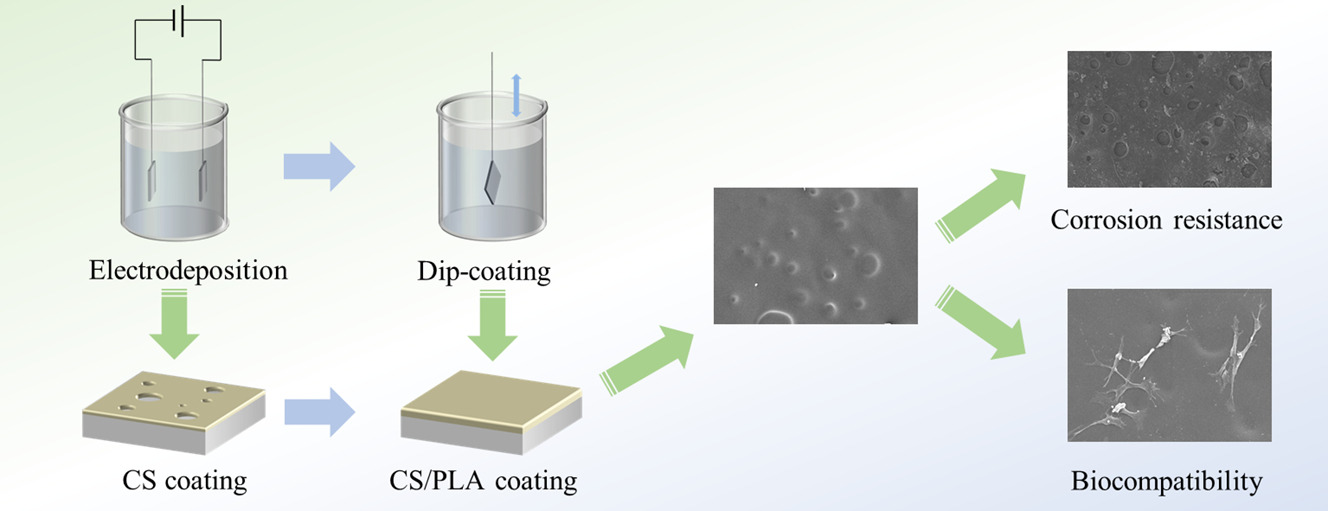
Abstract:Magnesium alloy is a potential biodegradable material and is widely used in medicine. However, its rapid degradation causes many negative effects and limits its application, so it is essential to improve corrosion resistance. In this study, a chitosan/polylactic acid composite coating was designed on the AZ31 alloy for medical applications. The composite coating sealed the pores of the chitosan layer to provide strong protection for the AZ31 alloy, with a reduced corrosion current density by 4 orders of magnitude. The excellent biocompatibility of the composite coating was proved by an increased cell viability test and morphology of cells adhered to the chitosan/polylactic acid coated sample. The composite coating provides a feasible method to enhance the corrosion resistance and biocompatibility of magnesium alloys.
DOI Number:10.1016/j.porgcoat.2023.107469
Impact Factor:7.3
Prev One:A calcium phosphate coating improving corrosion resistance of the biodegradable magnesium alloy with graphene oxide modifying the deposition
Next One:Double-layer calcium phosphate sandwiched siloxane composite coating to enhance corrosion resistance and biocompatibility of magnesium alloys for bone tissue engineering
Tianxiao Wang, the assistant professor, obtained his doctoral degree from Jilin University, China in 2023. Then, he worked as a postdoc at Umeå University, Sweden from 2023 to 2025. His research interests include anti-fouling coating, microbiological influenced corrosion and biomedical materials especially magnesium alloy based biomaterials. He have published over 10 papers on journals including Journal of Magnesium Alloys, Progess of Organic Coatings and Ceramisc International and so on. The students who are interested in corrosion resistant coatings and biomaterials are welcomed.

