
王天笑
Assistant Professor Supervisor of Master's Candidates
Gender:Male
Alma Mater:吉林大学
Degree:Doctoral Degree
School/Department:化工学院
Discipline:Chemical Engineering
E-Mail:
Hits:
Date:2026-01-10
Links to Published Journals:https://pubs.acs.org/doi/10.1021/acsanm.2c04778
Indexed by:Journal Article
Date of Publication:2022-11-23
Journal:ACS Applied Nano Materials
Included Journals:SCI
Volume:5
Issue:12
Page Number:18965-18976
ISSN:2574-0970
Key Words:magnesium alloy, polycaprolactone, corrosion resistance, biocompatibility, antibacterial property
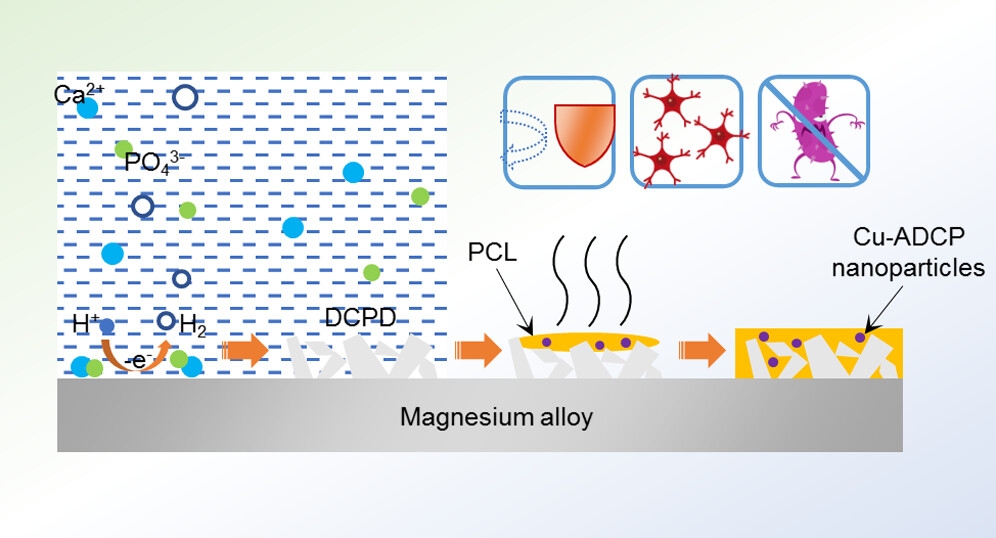
Abstract:cellent mechanical properties, while potential cytotoxicity with rapid degradation limits their clinical applications. Moreover, it is also important for implants to avoid inflammation caused by bacterial infections in the early stage of implantation. Therefore, copper-doped anhydrous calcium phosphate nanoparticles were fabricated by the hydrothermal method and dispersed in a dicalcium phosphate dihydrate (DCPD)/Polycaprolactone (PCL) composite coating to improve its bacteriostatic properties, corrosion resistance, and biocompatibility in this paper. The impedance of the DCPD/PCL/Cu-doped anhydrous calcium phosphate (Cu-ADCP) composite-coated sample is 1 order of magnitude higher than that of the bare magnesium alloy, and the corrosion current density decreases by 2 orders of magnitude, indicating that the composite coating incorporating nanoparticles can effectively enhance the corrosion resistance. The in vitro cell experiments show its biocompatibility with sustained growth in cellular activity and increased alkaline phosphatase activity. Most importantly, the embedded copper-doped nanoparticles significantly improve the antibacterial properties of the composite coating. Compared with the composite coating with almost no antibacterial ability, the antibacterial rate reached 96 and 98% for Escherichia coli and Staphylococcus aureus, respectively, after the nanoparticles were embedded, making them a promising choice for orthopedic applications.
DOI Number:10.1021/acsanm.2c04778
Impact Factor:5.5
Prev One:Double-layer calcium phosphate sandwiched siloxane composite coating to enhance corrosion resistance and biocompatibility of magnesium alloys for bone tissue engineering
Next One:Preparation of anticorrosion, biocompatible and antibacterial dicalcium phosphate dihydrate/polycaprolactone-titania composite coating on Mg alloy
Tianxiao Wang, the assistant professor, obtained his doctoral degree from Jilin University, China in 2023. Then, he worked as a postdoc at Umeå University, Sweden from 2023 to 2025. His research interests include anti-fouling coating, microbiological influenced corrosion and biomedical materials especially magnesium alloy based biomaterials. He have published over 10 papers on journals including Journal of Magnesium Alloys, Progess of Organic Coatings and Ceramisc International and so on. The students who are interested in corrosion resistant coatings and biomaterials are welcomed.

